Uno specchio d’acqua che segna un destino comune, che unisce e troppo spesso divide. Luogo di traffici e di scambi, punto d’incontro di culture, civiltà e religioni, ‘spazio-movimento’ nella definizione che ne dà Fernand Braudel, perché è ciò che storicamente lo attraversa – persone, merci, idee – a plasmarne l’identità.
Il Mediterraneo è uno ‘spazio-movimento’ in trasformazione: l’instabilità a lungo latente è deflagrata producendo un conflitto. Oggi più che mai, si avverte dunque l’esigenza di strumenti che aiutino a orientarci, a comprendere la complessità delle dinamiche politiche, economiche e sociali che segnano la regione, a interpretare il presente che stiamo vivendo e il futuro che ci attende.
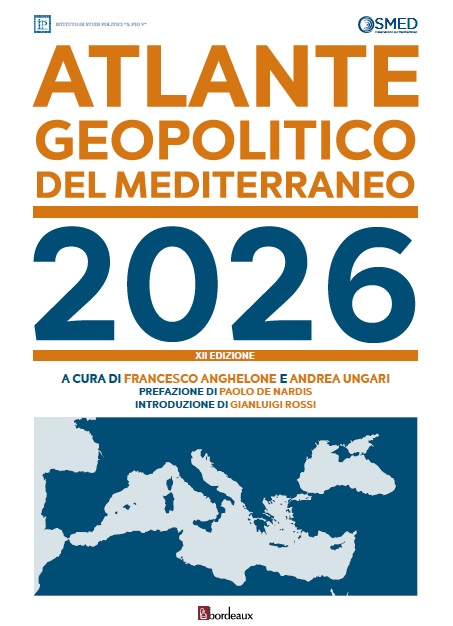
L’Atlante Geopolitico del Mediterraneo dell’Istituto di Studi Politici “S. Pio V”, giunto alla sua dodicesima edizione, continua a essere un punto di riferimento per la comunità degli studiosi, dei ricercatori ma anche dei lettori appassionati che vogliono provare ad analizzare i cambiamenti in corso nel bacino del Mare Nostrum, segnato dalla tragedia senza fine del conflitto israelo-palestinese e sconvolto dalla guerra che coinvolge Israele, Stati Uniti e Iran.
Nella sezione degli Approfondimenti, il saggio di Dalia Ghanem racconta la percezione che di Israele hanno gli Stati arabi della regione, con uno scollamento non di rado significativo tra cancellerie e opinioni pubbliche. Il contributo di Nimrod Goren ribalta invece la prospettiva e descrive come Israele percepisce se stesso dopo il 7 ottobre, restituendo la fotografia di un Paese che spesso si ritiene incompreso dagli alleati ma in cui parte della società civile non si esime da un approfondito esame di coscienza.
La sezione delle Schede Paesi offre poi una ricostruzione storica e una lettura aggiornata delle dinamiche politiche, economiche, sociali e internazionali degli 11 Stati della sponda sud del Mediterraneo, con il solido supporto di un ricchissimo e aggiornato apparato di statistiche e dati.
Infine, la sezione dei Dialoghi mediterranei inquadra il ruolo di alcuni rilevanti attori politici nell’area e come essi abbiano reagito alla crescente instabilità che l’attraversa.
Il risultato è un’opera scientificamente solida ma anche di facile consultazione, indispensabile per capire il Mediterraneo in uno dei momenti più travagliati della sua millenaria storia.
Con un monito all’Europa, affinché sia consapevole del suo ruolo e si adoperi per il rilancio di una decisa azione politica nella regione. Perché, come diceva Aldo Moro, «Nessuno è chiamato a scegliere tra l’essere in Europa e essere nel Mediterraneo, poiché l’Europa intera è nel Mediterraneo».
A body of water that marks a shared destiny, that unites and too often divides. A place of trade and exchange, a meeting point of cultures, civilisations and religions, a “space-movement” in Fernand Braudel’s definition, because it is what historically crosses it — people, goods, ideas — that shapes its identity.
The Mediterranean is a “space-movement” in transformation: long-latent instability has erupted into conflict. Now more than ever, there is a need for tools that help us find our bearings, understand the complexity of the political, economic and social dynamics that define the region, interpret the present we are living through and the future that awaits us.
The Geopolitical Atlas of the Mediterranean of the Institute of Political Studies “S. Pio V”, now in its 12th edition, continues to be a point of reference for the scholarly and research community, as well as for passionate readers who wish to analyse the changes underway in the Mediterranean basin — marked by the endless tragedy of the Israeli-Palestinian conflict and shaken by the war involving Israel, the United States and Iran.
In the Essays section, Dalia Ghanem’s essay explores how Arab states in the region perceive Israel, revealing a gap that is often significant between governments and public opinion. Nimrod Goren’s contribution reverses the perspective and describes how Israel perceives itself after 7 October, painting the picture of a country that often feels misunderstood by its allies, yet in which part of civil society does not shy away from deep self-examination.
The Country Profiles section offers a historical overview and an up-to-date reading of the political, economic, social and international dynamics of the 11 states on the southern shore of the Mediterranean, supported by a rich and comprehensive set of statistics and data.
Finally, the Mediterranean Dialogues section frames the role of key political actors in the area and how they have responded to the growing instability running through it.
The result is a scientifically rigorous yet accessible work, indispensable for understanding the Mediterranean at one of the most tormented moments in its millennia-long history.
With a warning to Europe, to be aware of its role and to work towards relaunching a determined political engagement in the region. Because, as Aldo Moro once said, “No one is called upon to choose between being in Europe and being in the Mediterranean, for the whole of Europe is in the Mediterranean.”